

The potential ROI of marketing for manufacturers has been proven time and again in B2B industry research. We’ve assembled 40 such stats here to demonstrate the positive impact that marketing can have on a manufacturing company’s bottom line.
We don’t traditionally view manufacturing as a space synonymous with marketing. In fact, HBR once asked if manufacturing and marketing could even coexist. But that was 1977. In the 21st century, it’s impossible to understate the potential value of marketing for manufacturers.
Manufacturer Marketing Matters! — Proof in 10 Stats
McKinsey reported back in the aftermath of the Great Recession that the traditional view of manufacturing—as entirely separate from services like advertising and marketing—had already grown outdated. The stats in their research backed up this assertion:
“In the United States, every dollar of manufacturing output requires 19 cents of services. And in some manufacturing industries, more than half of all employees work in service roles.”
It’s true that manufacturing companies—especially tier 1, 2, and 3 suppliers—are historically accustomed to operating mostly behind the scenes while the consumer-facing end of the supply chain focuses on messaging. However, the nurturing of critical business-to-business (B2B) relationships also requires a certain degree of brand awareness, product differentiation, and a well-articulated value offer. This is truer than ever in a digital age in which:
- 67% of the buyer’s journey now takes place online (largely through buyer-controlled internet research).
- 84% of people use the internet first when they need new information. Your manufacturing partners are likely to use search engines for finding suppliers, components, and services.
- U.S. digital ad spending surpassed all traditional advertising combined in 2019.
- B2B buyers average 12 Google searches before engaging with a brand’s website.
The domination of digital customer research and internet-based B2B sales will only continue to grow throughout the 2020s. This is only one of many reasons that the value of marketing for manufacturers is ascending to unprecedented heights.
However, top industrial sites are only converting 3% of traffic with RFQs and contact forms, vs. target conversion rates of 10% or more. One potential cause could be that the majority (57%) of manufacturers have a small (or single person) marketing team serving the entire organization, per CMI’s 2017 Manufacturing study. Just 19% of manufacturing marketers considered their marketing efforts to be at a “sophisticated” or “mature” level that year, compared to 28% of B2B marketers as a whole.
Successful marketing for manufacturers will take a more serious approach to the evolving sales funnel. We’ve collected the following additional stats to lay out the case!

30 More Stats on Marketing For Manufacturers:
The Value of SEO, Web, & Inbound Marketing For Manufacturers
Your website is your best salesperson. The inbound orientation of many modern leads will make strong performance on the search engine results page (SERP) essential for boosting valuable web traffic, and ultimately, sales. How valuable? Well:
- The majority of industrial buyers (53% as of 2017) make purchases online.
- Manufacturer and industrial website usage has risen 12% since the onset of the COVID-19 pandemic, according to the 2020 Thomas Industrial Survey. A website optimized for conversions will capitalize on this newfound traffic.
- U.S. consumers spend more time on mobile devices than watching TV (3 hours and 10 minutes a day in 2019). The web gets more eyeballs than any other channel these days. Web ads, web content, your website, and search engine optimization are your best opportunities to capture buyer attention. Optimize for mobile!
The Value of Content Marketing For Manufacturers
We live in an increasingly “inbound” world, even in the realm of manufacturing marketing. Buyers want to learn about your company on their own, so it pays to have materials that will turn up in their self-directed research. Here’s why you should prioritize content that educates and engages your inbound leads through a business blog, downloadable assets, video, and more.
- 8 in 10 decision-makers would rather read articles than view ads to learn about your company.
- 72% of customers prefer to learn about a product or service through video. Leverage online marketing content like video tutorials, webinars, vlogs, demos, and more!
- Case studies convert and accelerate the most leads among all demand generation channels. Indeed, 89% of B2B marketers say case studies are their most effective marketing assets. Craft case study content about current or past clients/distributors that highlight the value and profitability of working with your company.
- 87% of B2B buyers go with brands that have relevant content for all stages of decision-making.
- Conversion rates go up by 73% with content that’s well-aligned to the buyer’s journey.
- 11+ business blogs per month will earn triple the traffic of 0-1 blogs per month in a B2B setting.
- 79% of potential buyers are willing to exchange personal contact information for a webinar (the highest rated channel), and 75% will do so for a white paper (second highest).
- 47% of buyers need to see 3-5 pieces of content before they will want to talk directly with a member of the sales team.
- Content isn’t always about making the sale. 81% of manufacturing companies say that the purpose of their content creation efforts is brand awareness.
- Personalized content can help to increase sales by up to 20%.
The Value of Sales Enablement Tools For Manufacturers
One of the critical roles of your marketing department is to support and enable your sales team. Content and other collateral or assets created by marketing can cater directly to bottom-of-the-funnel decision-making stages or the specific objections or questions customers have when talking with sales reps.
- Companies with a dedicated sales enablement program improve sales quota attainment by 22% and win rates by 14% versus companies that don’t.
- 84% of sales reps achieve quotas when a company uses best-in-class sales enablement strategies.
- 90% of B2B sellers don’t even use existing sales materials because they’re outdated, irrelevant, or too hard to customize.
- The average salesperson spends 440 hours each year searching for the right content to share with customers.
- Organizations are 96% more likely to achieve a competitive level of sales sophistication with formal sales enablement initiatives. Use marketing assets as sales enablement tools to directly support sales and revenue growth.
The Value of Lead Nurturing For Manufacturers
Lead nurturing is critical to effective marketing for manufacturers, a sector that experiences longer-than-average sales cycles where leads can fall through the cracks. Manifacturing marketing automation, remarketing ads, email drip campaigns, marketing workflows, custom email sequences triggered by prospect actions, and more can have a massive impact on your bottom line.
- Lead nurturing excellence generates 50% more sales ready leads and 47% larger purchases at 33% lower costs, when compared with companies that don’t excel at lead nurturing.
- Marketing automation makes lead nurturing a breeze—and highly profitable. Aberdeen found that marketing automation leads to 107% better lead conversion, 40% larger deal sizes, 20% higher attainment quotas, and 17% improvements in forecast accuracy.
- Email marketing generates $44 for every $1 spent (4,400% ROI) and an email marketing agency can help you harness this potential, as email marketing also offers a higher conversion rate than social and organic search combined.
- 79% of B2B marketers rated email as the best channel for demand generation, and 59% say it’s also the top channel for generating revenue.
- Social lead nurturing is also valuable. LinkedIn alone is responsible for 80.33% of social media B2B leads, so make sure to reach out and stay in touch with prospects who have shown interest!
- 87% of buyers eventually make a purchase after attending an event or trade show. Collect leads at the booth, then nurture in the weeks that follow!
What Does It All Mean for Your Manufacturing Business?
Marketing is, statistically speaking, an underrepresented priority in the manufacturing industry. The 2017 Manufacturing Marketing study we mentioned near the beginning makes this clear, at least in terms of content marketing:
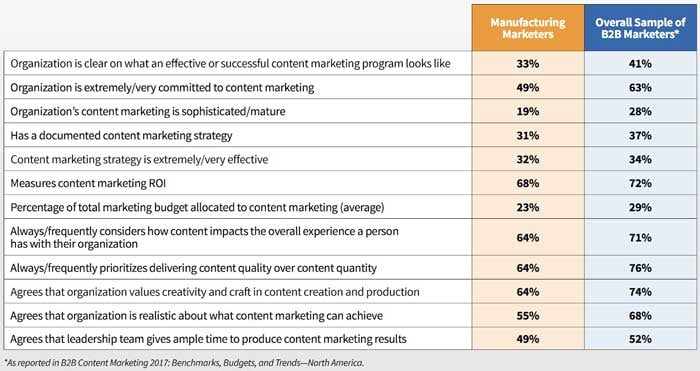
Source: Content Marketing Institute
But this doesn’t make it any less impactful or important. The most common issue is that small teams (or one marketing employee flying solo) make it difficult to devote the proper time and attention to achieve true marketing sophistication and success.
With a more comprehensive marketing strategy, your manufacturing company can realize truly exceptional boosts in metrics up and down the sales funnel: SERP rankings, web traffic, leads, conversions, quota attainment, win rates, deal sizes, revenue growth, ROI, and more! You can earn the results you want for less money than you’re spending now with a dedicated budget for expanded manufacturer marketing initiatives—especially through online, inbound channels.
Whether you grow a robust in-house team or seek outside help from an agency or BPO, there’s proven value in marketing for manufacturers. The stats speak for themselves.
AI Enters the Field
The biggest trend in marketing for manufacturers is the inclusion of AI in everything from consumer-facing chatbots to email automation.
- In 2023, 55% of businesses surveyed by McKinsey said they used AI in at least one business function. At the end of 2024, that number jumped to 78%.
- While there may be some concerns around having a chatbot handle some basic customer service tasks, those concerns appear to be unfounded. 80% of the people who have used a chatbot say it was a positive experience.
- Only 15% of marketers surveyed said that they use AI for research when developing a strategy.
- Businesses using chatbots have seen sales increase by 67%.
- Sales also have seen increases when AI is used to personalize each prospect's marketing strategy. In those cases, companies have reported a 40% increase in the average order value.
- 30% of marketing teams use AI for data analysis and insights.
Manufacturers Get Ready For Their Close-Up
Video-based content should be part of every manufacturer’s marketing plan. Not only do customers prefer to get certain content points via videos but video content prompts a better information recall too. Forbes found that when a message is delivered by video, it’s remembered by 95% of the people who see it. (And if you’re doubting that, ask anyone to sing the Kit-Kat commercial jingle.)
- When a video is the primary content-delivery vehicle, the click-through rate is over 90%.
- People are more engaged with videos now than ever before too. The total watch time for videos increased by 44% in 2024.
- Videos are shared 1200% more than a link or text content. Combined.
- B2B videos generate 41% more traffic from search engines vs other content formats.
The Swing to Social
Social media has emerged as a top-tier marketing tool for manufacturers because it supplies you with the potential for direct customer interactions in a way that’s never been seen before.
- According to estimates by Statista there are over 5 billion using some form of social media. Over 1 billion of those alone are on LinkedIn.
- 60% of B2B marketing teams see social media has proven to be the most effective B2B channel for driving revenue.
- Social is a tool that everyone on the team is turning to for research. 84% of senior purchasers (C-Suite) in the company include reviewing social media as part of their buying process.
- 63% of B2B customers have used social media as a way to get customer service help. That number is nearly 10 points higher than those who used more “traditional” customer service outlets.
- The reliance on social media to make purchasing decisions is not regulated to any particular global region. 77% of B2B purchasers in EMEA and 66% in Australia and the Pacific Region report that social-based content has helped them with a purchasing decision.
- Unsurprisingly, given the near constant emergence of one social platform after another, marketers say that their biggest challenge with social media is deciding where to put their focus.
Turn Customers into Content Creators (+ The Rise of Influencers)
Authenticity and trust are two big customer demands across the industrial marketplace. Including customer reviews and testimonials in your marketing strategy can bring both to current, and prospective customers.
Additionally, influencers have begun playing a larger role in industrial marketing.
- Influencer and customer created content can help you drive to the 90-9-1 rule. That says that 90% of the people online are passive users, 9% are re-sharers, and 1% actually create content. Getting that 1% to help create content for your company brings you new content, potentially new customers, and some industry clout.
- A study found that 54% of online users trust online reviews over what they hear from friends, family, and the company.
- It’s not just that people don’t trust the claims of a company, they REALLY don’t trust them. 97% of consumers say that Fortune 500/1000 companies exaggerate when talking about the value their products and services contain.
- 67% of consumers will change their mind about making a purchase if they read a negative review of the product or service.
- If you are thinking about getting a celebrity spokesperson, hold that thought. 92% of consumers trust an influencer more than a celebrity.
Developing a Strong SEO Strategy
From the dawn of the Internet, SEO has been an important piece of the equation for marketers. It remains integral to every marketing plan. It is, in some ways, the engine for a marketing strategy and like any engine, needs to be tuned-up and maintained.
- 39% of marketing professionals said using keywords to optimize page content was their top SEO strategy.
- Utilizing “visual content” more is the SEO strategy of 21% of marketing teams.
- Infographics can increase traffic to a webpage by over 10%. This is why nearly 90% of marketers say that they will be increasing their use of infographics.